Last updated on July 23rd, 2026 at 02:54 pm
Have you ever been enjoying a trip or working abroad when you suddenly needed to withdraw cash or make a payment, only to have your ATM card rejected by the machine? Or been in a hurry to send money to your family back home, only to find that the process took forever and the fees were a shock?
Don’t worry—this is a problem that Indonesian expats, students, and businesspeople face all the time. The good news is that several major banks in Indonesia already have robust international networks to support your mobility. Let’s go over them one by one, along with the most efficient solutions if your main goal is to send money abroad.
1. BCA (Bank Central Asia)
BCA has the most extensive network of ATMs and partner institutions in Indonesia, and its cards are compatible with both the Visa and Mastercard global networks, allowing customers to withdraw cash at ATMs abroad.
Here are some facilities you can take advantage of:
- Withdraw cash at ATMs bearing the Visa or Mastercard logo in various countries
- Online shopping on global platforms such as Amazon or AliExpress
- Send money internationally via BCA Remittance
- A debit card that can be used immediately for global transactions without opening a new account
It’s important to note that every international transaction is typically subject to an administrative fee plus a currency conversion fee, generally ranging from 1 to 31 TP3T per transaction.
2. Bank Mandiri
As the largest state-owned bank, Mandiri has also established a robust cross-border transaction infrastructure, complete with several overseas branches.
- Visa/Mastercard debit cards that can be used at ATMs and EDC terminals worldwide
- Mandiri Remittance Service, with coverage in Singapore, Hong Kong, Malaysia, and other countries
- Livin’ by Mandiri remains accessible from abroad as long as you can still receive OTPs or use a digital token
For students or migrant workers, Mandiri’s branches in Singapore and Hong Kong are often a lifeline when they need in-person service.
3. BNI (Bank Negara Indonesia)
BNI is among the most aggressive in expanding its overseas network, with branch offices in several major cities around the world: Tokyo, Seoul, London, New York, Hong Kong, and Singapore.
Its flagship services:
- BNI Smart Remittance for international transfers at more affordable rates
- A debit card accepted on the Visa and Mastercard networks worldwide
- BNI Mobile Banking, which can be accessed anytime as long as you have an internet connection
These BNI branches also frequently collaborate with universities and diaspora communities, so they’re quite welcoming to Indonesian students studying abroad.
4. CIMB Niaga
Because it is a subsidiary of the Malaysia-based CIMB Group, CIMB Niaga automatically has access to a broader network in Southeast Asia than most other local banks.
- Visa/Mastercard debit and credit cards accepted in many countries
- Octo Mobile for international transfers and payments right at your fingertips
- CIMB Preferred International Access priority services at branches in Singapore, Malaysia, and Thailand
- CIMB Niaga International Remittance, which is connected to more than 100 correspondent banks worldwide
Read Also: Send Money Abroad Faster, Cheaper, and Safer
5. Bank Danamon
Danamon does not yet have many branches overseas, but its cards comply with Visa/Mastercard network standards, so they can be used for global transactions. For money transfers, Danamon partners with Western Union, and customers can still access their accounts via Danamon Online Banking from anywhere.
6. PermataBank
Through its partnership with Standard Chartered Bank, PermataBank is introducing PermataMobile X with the following features:
- International transfers to more than 50 countries
- Cash withdrawals at ATMs abroad bearing the Visa or Mastercard logo
- Real-time notifications and automatic currency conversion right in the app
7. BRI, BTN, and OCBC NISP
These three banks are also continuing to expand their international reach:
- BRI using BRIfast Remittance and a global debit card
- BTN focuses on the convenience of cash withdrawals and using debit cards abroad
- OCBC NISP Benefiting from the OCBC Group’s network in Singapore, this is perfect for those who frequently travel between Indonesia and Singapore
Three Types of Services That Are Generally Available
Although policies vary from bank to bank, there are generally three main services you can use while abroad:
- International debit card: Cards bearing the Visa, Mastercard, or Plus/Cirrus logos can generally be used at ATMs abroad, provided that the international transaction feature has been enabled in advance through the mobile banking app.
- Money transfer services (international transfers): Cross-border transfers are typically processed through the SWIFT network or via interbank remittances, with a processing time of 1–3 business days. Unfortunately, interbank transfer fees can be quite high, starting at hundreds of thousands of rupiah per transaction, not including fees charged by correspondent banks.
- Internet and mobile banking: As long as you have an internet connection, you can log in to your account from anywhere. The challenge is that some apps still rely on OTPs via SMS, which can be a problem if your local phone number isn’t active while you’re abroad.
Read Also: 8 Easy Ways to Transfer Money Abroad
What Are the Requirements for Using a Debit Card Abroad?
Having an account at one of the banks listed above does not necessarily mean that all your cards will automatically work abroad. Keep the following points in mind before you leave.
-
Check the circuitry on the card
Make sure your card is part of an international network, such as Visa or Mastercard. When you want to make a cash withdrawal, look for an ATM that displays the same network logo as your card.
-
Enable international transactions
Some banks require customers to enable international transactions, debit card roaming, or overseas card use through their mobile banking app.
It is best to make these arrangements before departure so that the card is not declined when used.
-
Check the transaction limit
Cash withdrawal limits, merchant payments, contactless transactions, and online payments may vary by card type.
Set a limit based on your needs, but avoid setting the limit too high to reduce the risk of card misuse.
-
Make sure your Indonesian number remains active
Some transactions or changes to your settings require an OTP sent to your registered cell phone number. Enable roaming, use an SMS reception service, or make sure your app’s authentication method remains available while you’re abroad.
-
Set up a backup payment method
Don’t rely on just one card. Network issues, a blocked card, an incompatible ATM, or transaction limits can cause a payment to fail.
Have a backup card, enough cash, or another digital payment method on hand in case of an emergency.
Read Also: Studying Abroad: Methods, Preparations and Requirements
Fees for Using Bank Indonesia Abroad
Overseas transaction fees vary depending on the bank’s policies, the type of card, the account currency, the ATM network, and the country where the transaction takes place.
Some cost components to consider include:
- Cash advance fees charged by the card-issuing bank.
- Access fees charged by banks or ATM owners overseas.
- Currency conversion fees.
- The difference between the selling and buying exchange rates.
- Fees for failed transactions or balance inquiries.
- International transfer fees.
- A fee charged by a correspondent bank for a specific transaction.
For example, BCA charges a fee of Rp20,000 for cash withdrawals through the Cirrus network, while Mandiri charges a fee of Rp25,000 for withdrawals using rupiah funds. Other fees charged by the ATM operator or related to currency conversion may still apply.
When an ATM offers the option to convert directly to rupiah, check the exchange rate first. The rate offered by the ATM operator may differ from that of the card-issuing bank and may involve additional conversion fees.
How to Choose a Bank to Use Abroad
No single bank is always the best fit for everyone. The best choice depends on your transaction needs.
-
For a short vacation
Choose a Visa or Mastercard debit card that’s easy to activate for international transactions. Also check the cash withdrawal fees and contactless capabilities.
-
To study or live abroad
Consider opening a multicurrency account so you can hold the currency of your destination country and reduce the need for repeated currency conversions.
-
For trips to several countries
Use a bank that offers a wide selection of foreign currencies and allows you to link your foreign currency account directly to your debit card.
-
For supplier payments or business needs
Remittance services are a better option than debit cards. Be sure to consider transfer fees, exchange rates, estimated delivery times, transaction documents, and the amount the supplier will receive.
-
To send money to family
Choose a service that provides information on fees and exchange rates from the start and can send funds directly to the recipient’s account.
Conclusion
There are many Indonesian banks that can be used abroad, including BCA, Mandiri, BNI, CIMB Niaga, OCBC, PermataBank, Danamon, Bank Jago, and BRI. Each bank offers different advantages, such as international debit cards, multicurrency accounts, cash withdrawals, mobile banking, or remittance services.
Before traveling, make sure your card supports international networks, that the overseas transaction feature is enabled, that you have a sufficient credit limit, and that the registered mobile number can still receive verification codes.
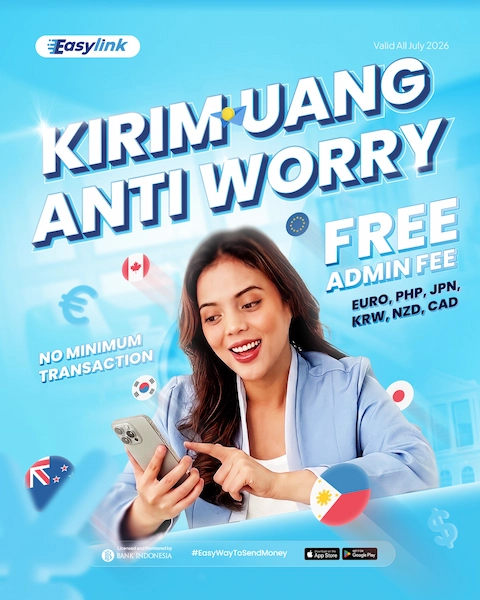
Meanwhile, if you need to send money to your family, pay for education expenses, or make business payments overseas, you can use Easylink.
With Easylink, you can send money to more than 170 countries and in 29 local currencies, with administrative fees starting at Rp30,000 for certain countries.
Download Easylink Now you can send money abroad more easily, securely, and conveniently.